
Muscle Fibers Effect on Athletic Performance
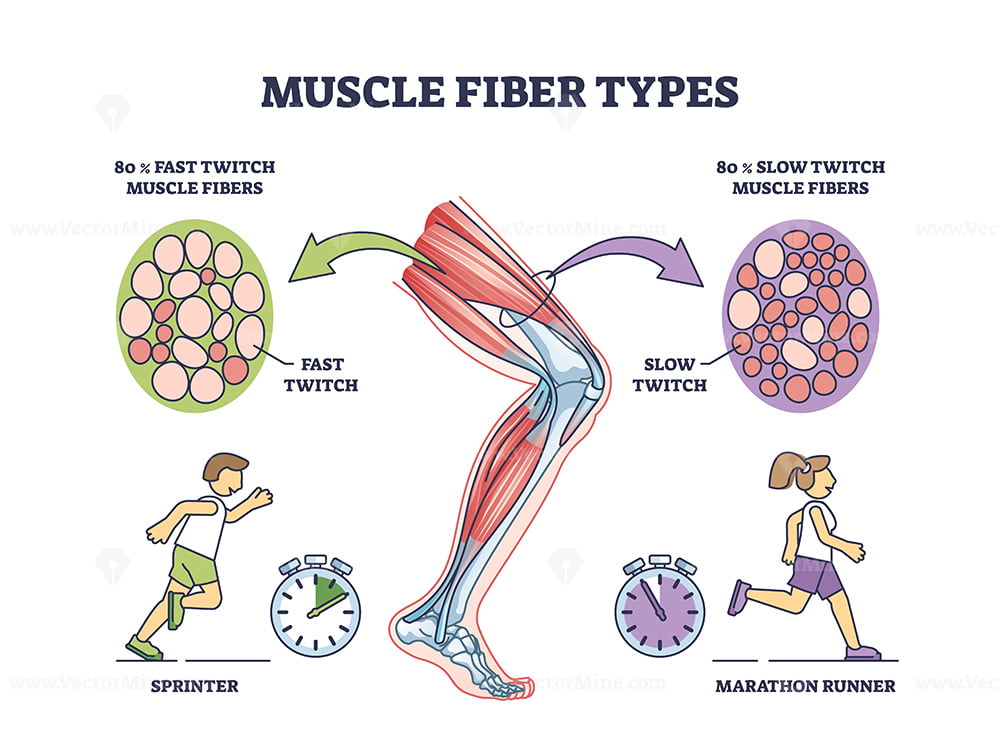
Skeletal muscle fibers have multiple types and different actions. Different forces or demands on the body will dictate which types of muscle fibers need to be used to complete the task at hand. These fibers play major roles in how quickly and efficiently one moves. Understanding how these fibers work, and what their roles are is vital to maximizing athletic
performance. In this research article the effects that muscle fumblers have on athletic performance will be covered.
The first thing to cover are the muscle fiber types. Type one muscle fibers are slow twitch fibers that do not fatigue quickly. Type 2A muscle fibers are known to be the middle ground between type one and type 2B muscle fibers. These fibers have characteristics from both type one, and type 2B muscle fibers. For example, type 2A fibers do produce ATP relatively quickly,
but at the same time do not fatigue quickly. The last type of muscle fiber to cover is type 2B. Type 2B muscle muscle fibers are known as fast twitch fibers. These fibers produce ATP very
quickly, and fatigue very quickly as well.
Now that there is an understanding of the fibers and their actions, the effects of these fibers can be covered. Athletic performance depends on many things. One of those being muscle fiber actions. The following piece from (Stephan van der Zwaard, Franck Brocherie and Richard T. Jaspers et al., 2021 ) explains why type one muscle fibers have been found to be
most useful in endurance athletes; “ Muscle fiber type is important for endurance, and its characteristics have been reviewed in detail elsewhere (Schiaffino and Reggiani, 2011). Researchers in the 1970–80s extensively investigated muscle fiber type composition in athletes
(Gollnick et al., 1972; Costill et al., 1976; Komi et al., 1977; Saltin et al., 1977; Hagerman and Staron, 1983; Tesch et al., 1984; Tesch and Karlsson, 1985; Yazvikov et al., 1988). They discovered that long-distance runners, rowers, swimmers, and kayakers predominantly had slow type-I muscle fibers (~70–80%), in greater proportion than long-distance speed skaters,
middle-distance runners, skiers and cyclists (~50–60%), jumpers, and throwers (~40–50%), weight lifters, wrestlers, powerlifters, and sprint speed skaters (~25–45%) or sprint runners
(~25%).” As covered in the paragraph above, type one muscle fibers do not fatigue quickly. That is why endurance athletes require more of these fibers for their specific sport than either type 2A or 2B fibers.
On the other hand, type 2A and 2B fibers are responsible for more explosive and intense movements. These fibers do fatigue quickly, but they do produce ATP quickly. ATP is the energy system predominantly used for quick explosive movements. Being able to recruit as many of these fibers as possible is important for maximal force outputs and quick explosive movements.
“Recent literature confirmed that a champion sprint runner had only a limited proportion of type-I fibers (29%), but a high percentage of powerful type-II fibers (Trappe et al., 2015)”(Stephan van der Zwaard, Franck Brocherie and Richard T. Jaspers et al., 2021). This is a great example of
the type of athlete that has more type 2 fibers than type one. Skeletal muscle fibers have multiple types and different actions. Type one fibers are
known to be slow twitch and are more prominent in endurance athletes. Type 2A and 2B fibers are known to be fast twitch and are more prominent in explosive athletes (I.E. sprinters, powerlifters, football players, etc.). These fibers have a huge effect on athletic performance. That is why it is vital for exercise professionals to understand the different types of fibers and
how they work. This will ensure that the exercises prescribed in a training plan will develop the fibers needed for a specific sport or activity.
References:
Stephan van der Zwaard, Franck Brocherie and Richard T. Jaspers, Under the Hood: Skeletal
Muscle Determinants of Endurance Performance,
https://www.frontiersin.org/articles/10.3389/fspor.2021.719434/ful