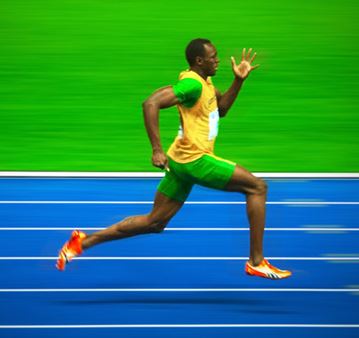
Good running technique is something that is underestimated and quite frankly hard to come by. There is a lot more that goes into proper running form than most trainers think. Running (especially sprinting) is a high intensity full body movement that involves much more than just the lower limbs. When running is being coached there are multiple areas to look for. This includes the following; arm swing, postural alignment, leg cycling and foot strike position,
shin angles and ankle dorsiflexion. Below I will break down each subdivision of running, the common errors in that subdivision, and cues to help correct those errors.
First up is arm swing. Just like when jumping, arm swing and movement is vital for great running technique. To use the arms properly one must keep a 90 degree bend in the arm while swinging, and keep the arms tight to the body. I like to use the cue “keep an L in the arm while running”. This helps runners focus more on moving from the shoulder joint rather than the elbow
joint. The other cue I like to use for those who struggle with flailing arms is “act as if you are running in a very narrow hallway, and you are not allowed to knock the e walls down.” Sometimes I will even hold dowels in the correct position and just have the athlete practice good arms swings inside of the space that is desired.
The second part of running to cover is postural alignment. The most common mistakes here are either running in a slouched position, or running too tall. There are three phases of running, drive phase, acceleration, and top end. Oftentimes people will get caught getting too tall too early. For this error I use the cue “imagine you are trying to put your head through the middle of a window that is three feet from ground level”. I will also use an adjustable hurdle to have them run under. This helps them stay lower for longer. Unfortunately, athletes will just slouch to stay low which is also a mistake. To fix this I will have them practice moving their spine in segments while looking in a mirror. I have found that visuals can really help athletes become
aware of the problem at hand and help them fix it faster. Postural control is a huge reason why sprinting is so demanding on the core.
Next up is leg cycling and foot strike position. The biggest error I see here is athletes getting stuck cycling their legs behind the body. The cue I use to fix this is “cycle over the calf muscle, not behind it.” I will then have the athlete look in the mirror and practice both good cycling and bad cycling to see and feel the difference between the two. This will usually clean up
the foot strike position as well. If it does not clean up the foot strike position then I will breakdown each phase of running and where the foot should be striking relative to the rest of the body’s position. If the body is at a steeper angle the foot will strike further behind the hip, as the body gets taller the foot strike will come up under the hip more and more.
The last parts to cover are shin angles and ankle dorsiflexion. If the ankle is in a proper position then shin angles become much easier to achieve. If the ankle is not in the proper position I give the simple cue of “flex to toes up towards the ceiling.” This gets the athlete’s ankle into a safer position to strike the ground with a stiff joint. “Proper dorsiflexion allows for an
optimal foot strike and can contribute to fewer injuries by putting your foot in the best position to absorb the shock of landing”(Pearson, 2022). If shin angles are still poor I will use mirrors or videos for extras proprioception to show the athlete the difference between good and bad shin
angles. Again, visuals provide athletes with more feedback which can help them identify the problem and fix it quicker. A cue that has helped my athletes in the past is “keep the shin at a 45 degree angle with the toes flexed up. This should create a C shaped swoop where the shin and
ankle meet. If you have the C swoop then the shin and ankle are in good positions.”
If you want to be a great runner and not get injured you must have proper running form. Everything above lays out how to run properly and mitigate the risk of injury while running. Follow these guidelines to improve times during running events and prevent injuries. For people new to running just remember this is one of, if not the most high impact activity you can do. So
proper technique is vital to staying healthy and progressing through a good running program.
References
Pearson R. (2022). What is dorsiflexion? And how can it make you a better runner?, Runner’s
World Health>Injury
https://www.runnersworld.com/uk/health/injury/a41329624/dorsiflexion/